
Your Brand Merchandise
A business-wide AI audit and consulting engagement. In-person interviews with the whole team informed detailed process maps, seven prioritised recommendations and a costed implementation roadmap.
Overview
Your Brand Merchandise supplies branded products to businesses, taking work from an initial enquiry through sourcing, quoting, production and delivery. Much of that journey depended on people moving information between supplier websites, PowerPoint, Excel, Shopify and Sage.
We carried out a business-wide audit and consulting engagement, interviewing everyone in the team in person to understand their day-to-day work, recurring problems and priorities. The conversations covered how tasks were actually completed, where information was handed over and what made a straightforward job become difficult.
We turned that discovery into an interview summary, detailed process maps, an opportunity assessment and a costed implementation roadmap. The work gave the business seven prioritised recommendations, with a clear explanation of the problem each addressed and how it could fit into existing operations.
What the audit involved
Listening to the whole team
In-person interviews captured the different perspectives across leadership, operations and administration. We brought the findings together to identify recurring problems, the work that relied heavily on particular people and the practical considerations that would affect adoption. The aim was to understand both the business priorities and the experience of the people doing the work.
Mapping how the business works
We mapped three connected workflows: quote-to-order, order fulfilment and financial operations. The maps followed individual steps and decisions, making handoffs and repeated data entry visible. We marked time-consuming tasks, quality risks and critical bottlenecks so each proposed improvement could be traced back to a specific part of the operation.
Comparing the opportunities
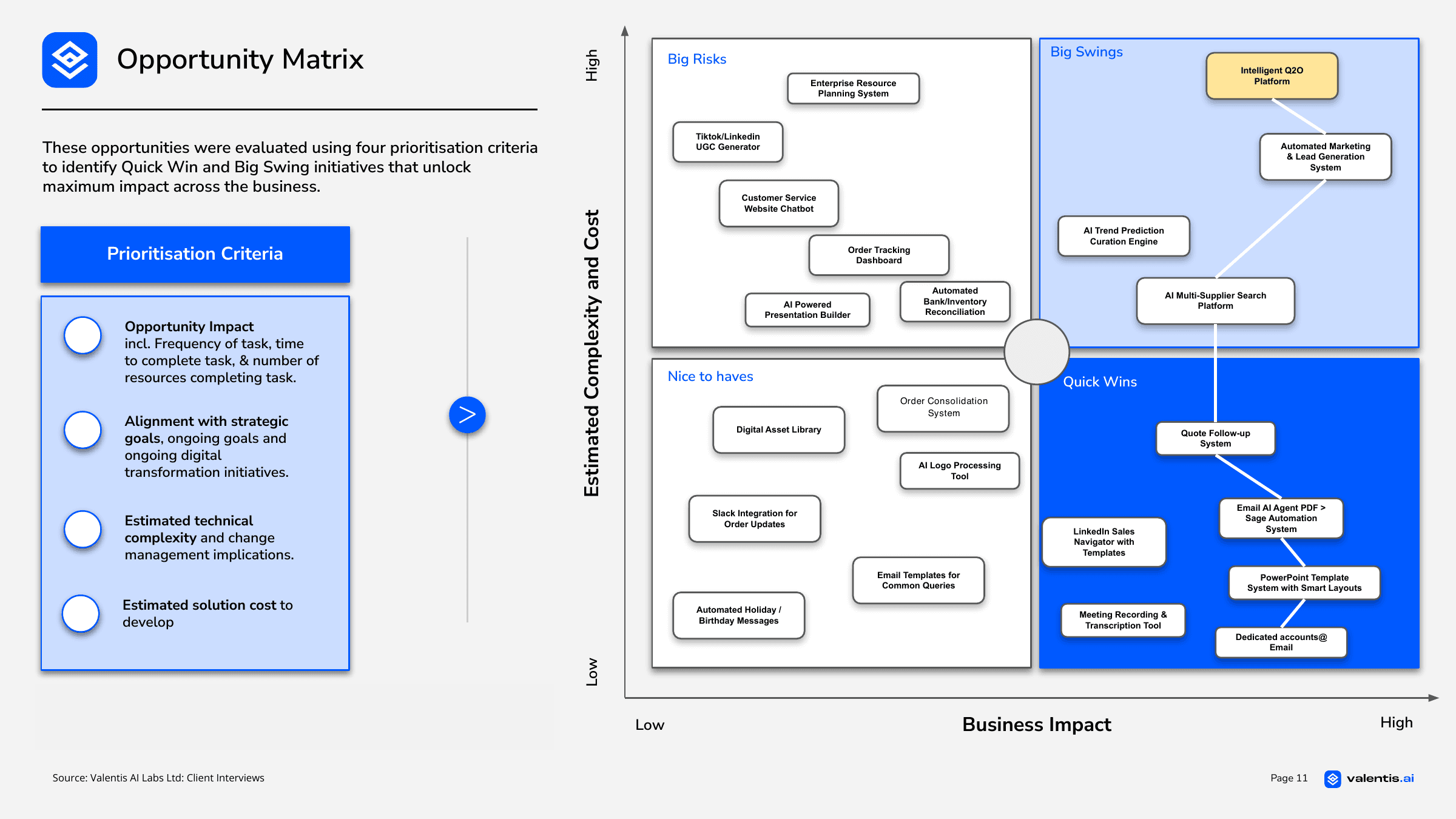
An opportunity matrix assessed ideas against their business impact, alignment with the company’s goals, technical complexity and estimated cost. It also considered the change required from the team. This helped separate useful early improvements from larger investments and ideas that could wait.
Building a commercial case
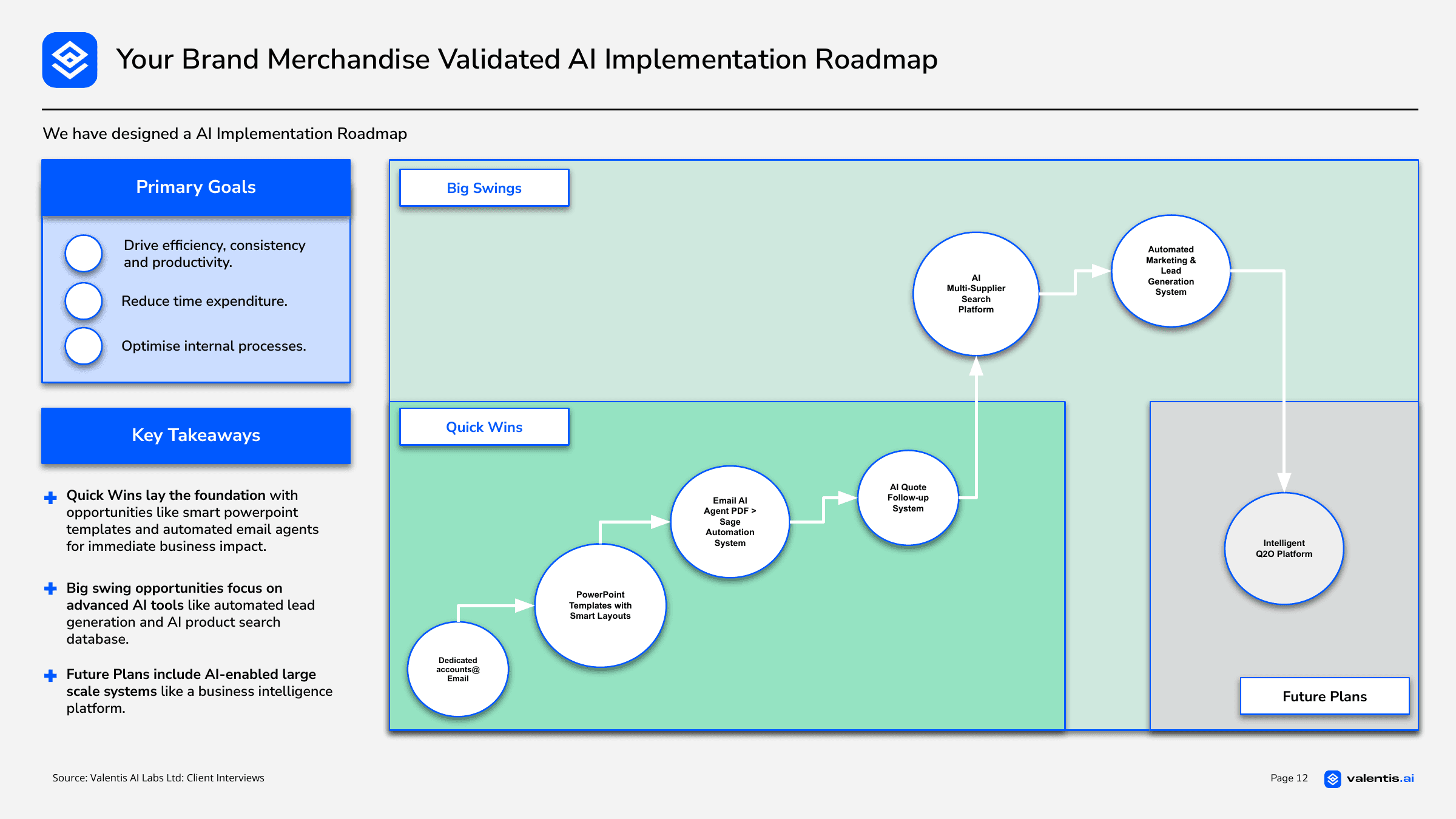
The selected recommendations included estimates for time saved, implementation cost, annual savings, potential revenue opportunities and payback. The roadmap set out a sequence for delivery, allowing the company to judge what to commission first and how smaller changes could support more ambitious systems later.
The three workflows we examined
Quote-to-order
From understanding an enquiry to finding products, calculating prices, preparing a presentation and confirming the order. The audit examined supplier research, artwork handling, quote preparation, follow-up and the transfer of information into the accounting system.
Order fulfilment
From the supplier purchase through production, shipping and final delivery. We examined supplier communication, order visibility, customs paperwork and stock reconciliation, including the interruptions caused when the team had to investigate a delivery problem.
Financial operations
From receiving a supplier invoice to recording it, billing the customer and tracking payment. The review looked at information arriving across inboxes, manual entry into Sage and the work needed to reconcile records and resolve missing details.
From small improvements to larger systems
The early recommendations combined straightforward process changes with targeted automation: a dedicated accounts inbox, reusable PowerPoint layouts, AI-assisted invoice processing and a systematic quote follow-up process. Each addressed a recognisable task, giving the team a practical starting point for improvement.
The larger proposals included a multi-supplier search platform to bring product research into one place, a lead generation system to support business development, and an integrated quote-to-order platform. For these, the assessment compared the existing process with the proposed workflow, showing how brief intake, product selection, pricing and presentation creation could connect.
The final deliverable was a decision-making tool for the business: what to improve, why it mattered, what it might cost and where to start. The commercial model identified more than £75,000 in potential annual savings and revenue opportunities combined. This was projected value from the audit, rather than measured returns from deployed software.