
Caramel.so
A shared context system for people and AI agents. It connects decisions, working knowledge and their original sources across projects and business workspaces, so each contributor can pick up the work with the right context.

Overview
A person and an agent can spend a session working through a problem and agreeing a direction. The next agent, project or tool still needs to know what was decided, why it matters and where that understanding came from. Without a shared record, the team ends up repeating the same briefing or losing the reasoning behind its choices.
We built Caramel.so to carry that context between people, autonomous agents and assisted sessions in tools such as Claude Code. It stores useful knowledge as explicit records: decisions, statements, opinions, answers, notes and briefings. Records sit within projects and business workspaces, with relationships and source references that explain their wider context.
The original evidence can remain in another app or data source. Caramel keeps the understanding gained from it connected to where it came from, so a future contributor can use what is already known and inspect the source when needed.
Inside the build
Context that travels with the work
People and agents contribute to a shared environment through the dashboard, API and MCP. A decision made in one session can inform another agent’s task, while shared sources and related-project references connect work that spans several projects or businesses.
Knowledge with its origins attached
A record can carry a source reference, related projects, people, tags, timestamps and confidence metadata. That gives the next contributor more than a detached summary: they can understand the record’s context and follow its reference to the original item. Directly authored opinions and decisions can also stand on their own.
A structure people and agents can navigate
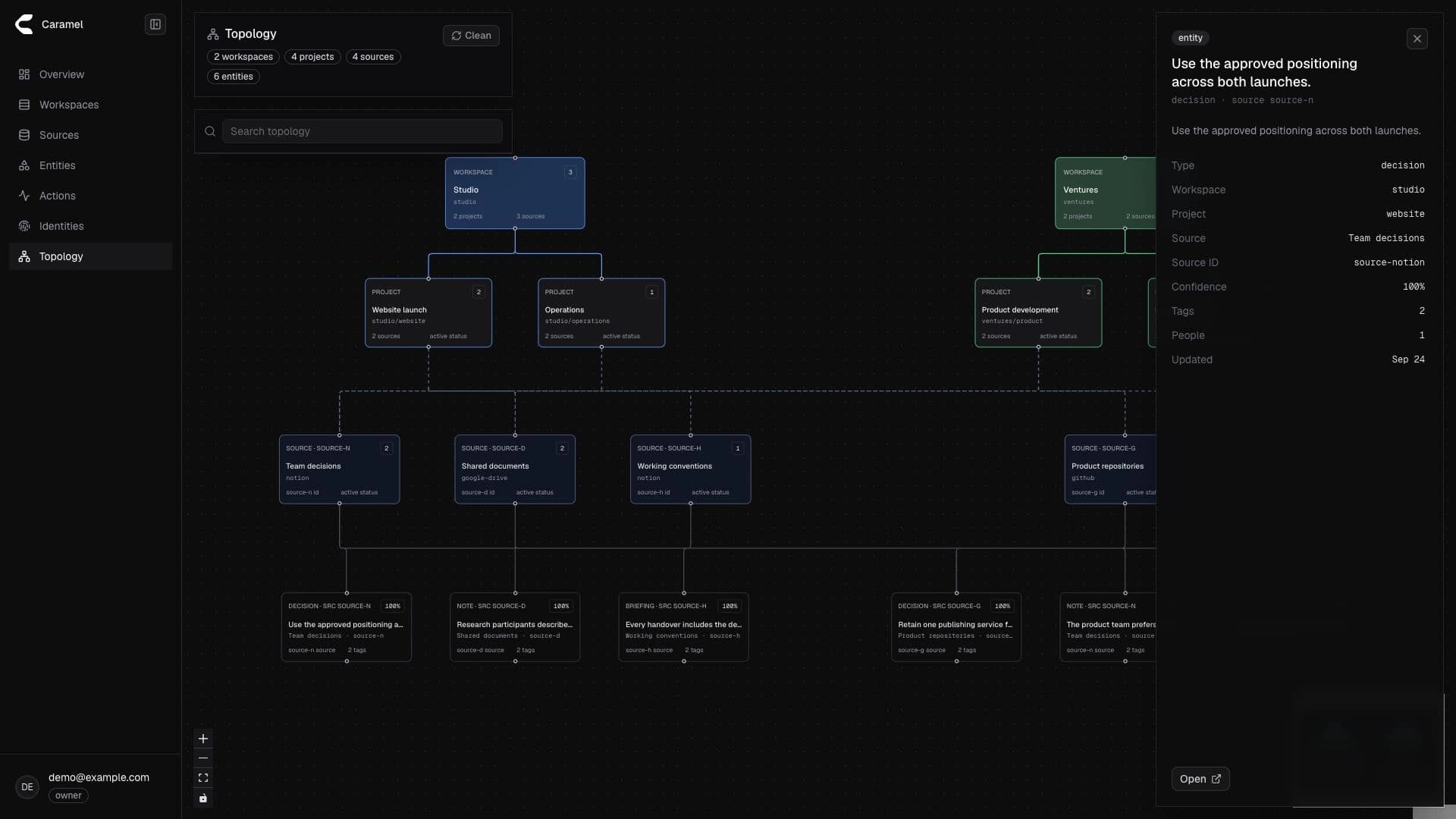
Agents can orient themselves within a workspace, drill into a project, search its records and fetch relevant sources. Human-written descriptions explain what those sources contain. The topology view lets people inspect how workspaces, projects, sources and context records connect.
Shared context, defined access
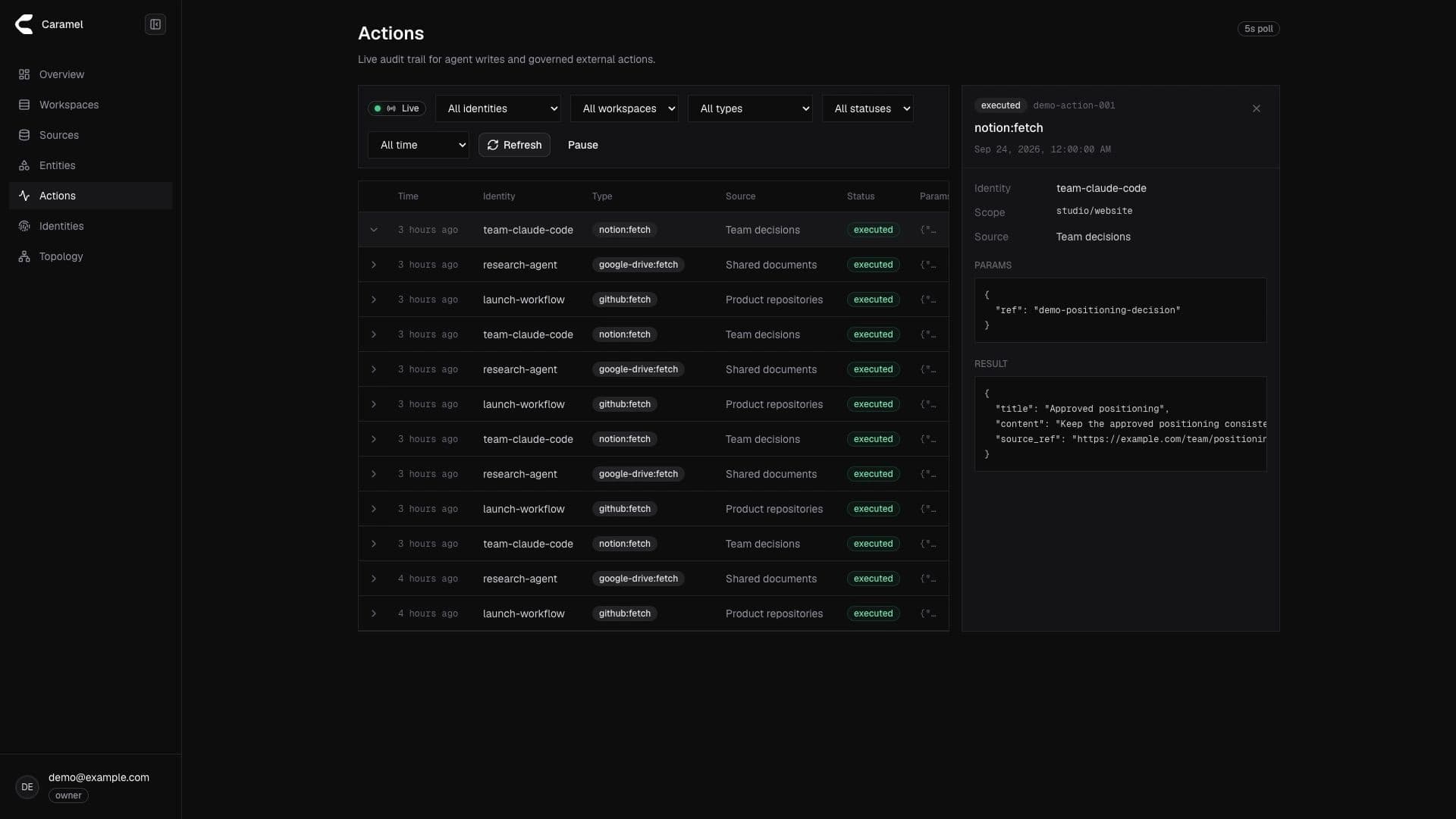
Each connected identity has its own scope and permissions. Agents see the workspaces, projects and sources they are allowed to use. Connected operations pass through an action gateway, with an audit trail showing who requested an action, its scope and the recorded result.
Implementation details
One context model, several ways to use it
A Postgres data model supports the dashboard, REST API and MCP tools. Records have explicit types, project relationships and source references. The current implementation uses scoped full-text search, with no embedding pipeline required to navigate or retrieve context.
Reading and contributing within a scope
MCP tools include orient, drill, search, fetch, remember and action. Agents can retrieve existing context and write useful records back while they work. Identity and source checks govern access, while the dashboard gives people a way to curate the environment and review activity.
Carry the decision into the next task
For example, a founder working with Claude Code could settle on a positioning change and record the decision in Caramel, linking the supporting brief. An agent preparing launch materials could then find that decision through the relevant project and source, rather than asking the founder to explain the choice again.
The launch agent could add what it learns as a new note or briefing. A person could review those records in the dashboard and inspect the activity behind them. The useful context survives the individual session and remains available to the next authorised contributor, whichever tool they work in.
This is deliberately a structured context system rather than a vector store or an undifferentiated document archive. It preserves what the team has learned, decided or expressed, together with its relationships and origins. Source retrieval is available when the work needs the original evidence or current information from another system.